
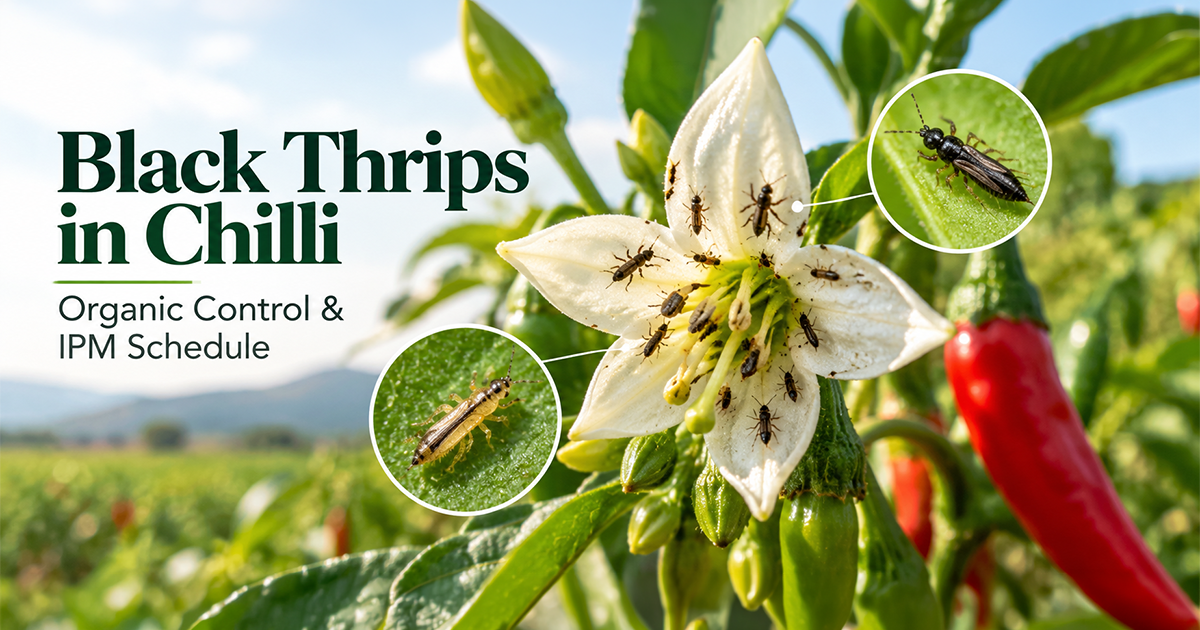
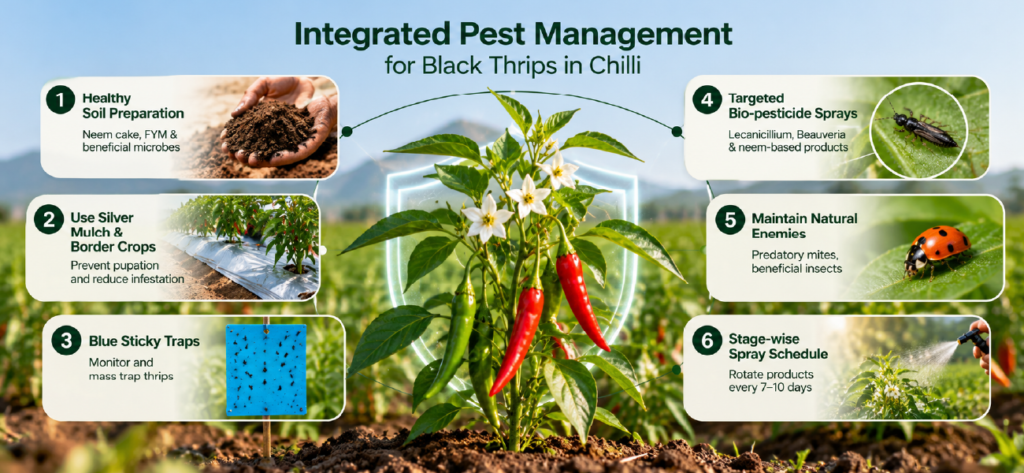
Black thrips (Thrips parvispinus) is an invasive pest that attacks chilli flowers, causing flower drop, poor fruit set and severe yield loss. It cannot be controlled by repeated chemical sprays alone. The most reliable approach is Integrated Pest Management (IPM): soil preparation, silver mulch, border crops, blue sticky traps and a rotation of bio-pesticides like Lecanicillium lecanii, Beauveria bassiana and neem-based azadirachtin.
Key takeaways
|
What Is Black Thrips?
Thrips parvispinus, called black thrips or South East Asian thrips, is an invasive pest now established in the chilli belts of Andhra Pradesh, Telangana and Karnataka. ICAR-IIHR reports 50–80% crop damage in affected southern states. Field surveys in major chilli-growing districts of Telangana have recorded even higher losses where the pest went unmanaged.
It also attacks papaya, brinjal, capsicum and several ornamentals, so it survives year-round on alternate hosts and weeds.
How to identify black thrips
Adult females: dark brown to black, larger
Adult males: yellowish, smaller
Where they hide: inside flowers (nectar area), on the underside of leaves near veins
Size: about 1 mm — use a hand lens and tap flowers over white paper to count them
Black thrips vs common chilli thrips: Common chilli thrips (Scirtothrips dorsalis) are pale yellow and mostly feed on tender leaves, causing upward leaf curl. Black thrips are darker and concentrate on flowers. Correct identification decides your spray target.
Damage Symptoms
Plant part | What you see |
|---|---|
Flowers | Browning, drying and withering; heavy flower drop |
Fruit set | Poor or no fruit set; aborted young fruits |
Fruits | Scarring, distortion, poor shine — lower market price |
Leaves | Reddish-brown scratches and punctures on the underside; distortion |
Whole plant | Stunted growth in severe infestation |
Why Chemical Sprays Alone Fail
A field survey across Telangana’s chilli districts found farmers in Khammam averaging nearly 30 insecticide sprays in a season — yet black thrips infestations kept growing. The study linked indiscriminate insecticide use to worsening outbreaks.
Three reasons chemicals alone fail:
Resistance builds fast. Thrips have a short life cycle and many generations per season.
Natural enemies die. Predatory mites, bugs and beneficial fungi are wiped out, so thrips bounce back faster.
Hidden life stages escape. Pupae in the soil and adults deep inside flowers are hard to reach.
Bio-pesticides break this cycle. They do not create resistance the way repeated chemical sprays do, and they spare most beneficial insects.
Stage-Wise IPM Schedule for Black Thrips in Chilli
Crop stage | Timing | What to do | Varsha products |
|---|---|---|---|
Land preparation | Before transplanting | Deep summer ploughing to expose pupae. Apply neem cake (about 200 kg/acre) and FYM or vermicompost enriched with Metarhizium or Pseudomonas | |
Nursery | 0–40 days | Place blue sticky traps at ground level near seedlings. Dip seedling roots in Pseudomonas before transplanting | |
Transplanting | Day 0 | Silver-coloured plastic mulch (25–30 micron) to stop pupation in soil. Sow 2–3 rows of maize or sorghum as a border barrier. Avoid close spacing (use 60×30 cm or 45×45 cm) | — |
Vegetative | Up to flowering | Monitor with blue sticky traps. Nip and destroy heavily infested shoot tips. At first sighting, spray Lecanicillium / Verticillium lecanii; alternate with neem-based spray | |
Flowering & fruit set (critical) | Peak risk period | Spray every 7–10 days, targeting flowers. Rotate Lecanicillium → Beauveria bassiana → azadirachtin. Increase to mass trapping | |
After harvest | End of season | Uproot and destroy crop residues. Remove weeds and volunteer plants that host thrips | — |
Blue sticky trap numbers
Purpose | Per hectare | Per acre (approx.) |
|---|---|---|
Monitoring | 20–25 traps | 8–10 traps |
Mass trapping | 65–75 traps | 26–30 traps |
Place traps at crop canopy height in the main field. Replace when the surface is full.
Intercropping option
Intercrop chilli with maize or sorghum and cowpea in a 10:3:1 row ratio. Maize/sorghum act as a physical barrier; cowpea helps build natural enemy populations.
Bio-Pesticide Rotation Kit for Black Thrips
Product | Active organism / ingredient | Role | Dosage |
|---|---|---|---|
VAKIL™ | Verticillium lecanii 1.5% LF | Infects sucking pests incl. thrips, whiteflies, aphids | 1 L/acre, foliar spray |
SHOCK™ | Lecanicillium lecanii | Entomopathogenic fungus for sucking pests | As per label |
TOXIN™ | Beauveria bassiana 1.15% WP | Broad-spectrum fungal infection of insects | 1–2 kg/acre |
BIOSTORM™ | Metarhizium anisopliae | Soil application against pupae in soil | As per label |
AGNEE® | Pseudomonas fluorescens 1% WP | Plant health, induced resistance, root dip | 1–2 kg/acre |
Azactin 10000 ppm | Azadirachtin (neem) | Antifeedant, repellent, growth disruptor | As per label |
VARSHANEEM | Cold-pressed neem oil | Repellent, supports rotation | As per label |
Research note: ICAR-NBAIR has reported effective management of black thrips using specific beneficial bacterial strains sprayed directly on chilli flowers and fruits — confirming that flower-targeted biological sprays work. |
How to Spray Bio-Pesticides for Best Results
Bio-pesticides are living organisms. How you spray matters as much as what you spray.
Spray early morning or late evening. Fungal spores need humidity; strong sunlight kills them.
Use enough water — about 200 L per acre — for full coverage.
Target flowers and leaf undersides. That is where black thrips live.
Add a compatible spreader-sticker for better coverage on waxy chilli leaves.
Use the spray solution the same day.
Keep a 5–7 day gap from chemical fungicides and bactericides. Never tank-mix them with fungal bio-pesticides.
Expect gradual control. Bio-pesticides infect and kill over several days, and the infection spreads through the pest population. Do not judge results after 24 hours.
Can You Combine Chemical and Biological Control?
Yes — that is what IPM means. If infestation crosses the threshold advised by your agriculture officer, use a recommended insecticide, then return to biologicals.
Rules:
Never repeat the same chemical group back-to-back. Rotate modes of action.
Keep a 5–7 day gap between chemical fungicides and fungal bio-pesticides.
Let bio-pesticides carry the load between chemical rounds to cut total chemical sprays.
Build Healthier Chilli from the Soil Up
Thrips-stressed plants recover faster with strong roots. Protect roots from wilt and root rot with Trichoderma — see our Trichoderma viride uses and dosage guide.
Shop Bio Insecticides | Get a Free Spray Schedule from Our Agronomist — call +91-8285684222 |
Frequently Asked Questions
1. How do I control black thrips in chilli organically?
Combine deep ploughing, neem cake, silver mulch, border crops of maize or sorghum, blue sticky traps and a rotation of Lecanicillium lecanii, Beauveria bassiana and azadirachtin sprays targeted at flowers.
2. Which bio-pesticide is best for black thrips?
No single product is enough. Rotate VAKIL™ (Verticillium lecanii), TOXIN™ (Beauveria bassiana) and Azactin (azadirachtin) every 7–10 days during flowering.
3. Blue or yellow sticky traps for thrips?
Blue. Thrips are strongly attracted to blue. Yellow traps are better for whiteflies and aphids.
4. Does neem oil kill black thrips?
Neem oil and azadirachtin mainly repel thrips, stop feeding and disrupt development. They work best as part of a rotation, not as the only spray.
5. When is black thrips damage highest?
During flowering and fruit set. Start monitoring from the nursery stage and intensify sprays once flowering begins.
6. How many bio-pesticide sprays are needed?
It depends on pest pressure. Monitor traps weekly and spray at 7–10 day intervals through the flowering period.
7. Can black thrips survive after the chilli crop is harvested?
Yes, on weeds, papaya, brinjal and other hosts. Destroy crop residues and weeds after harvest.
Sources
ICAR-IIHR — South East Asian Thrips (Thrips parvispinus): Monitoring, Diagnosis and Management in Chilli: https://www.iihr.res.in/sites/default/files/South%20East%20Asian%20Thrips%20(Thrips%20parvispinus)-Monitoring%20and%20Management_0.pdf
Insecticide use and T. parvispinus infestation in Telangana chilli districts (AATCC, 2024): https://aatcc.peerjournals.net/wp-content/uploads/2024/12/Indiscriminate-insecticides-use-in-chilli-exacerbates-T.-parvispinus-infestation-A-case-study-in-major-chilli-growing-areas-of-Telangana-State-India.pdf
Biological Control of Thrips parvispinus in Chilli (Agri Magazine, 2026): https://agrimagazine.in/wp-content/uploads/2026/01/E-AGM-02-10-131-441-444.pdf
Read more about: Trichoderma Viride Uses in Agriculture: Dosage per Acre,Application Methods & Expert Tips
Disclaimer: Follow the product label. For severe infestations, consult your local agriculture officer, KVK or Horticulture Department for current recommendations.