

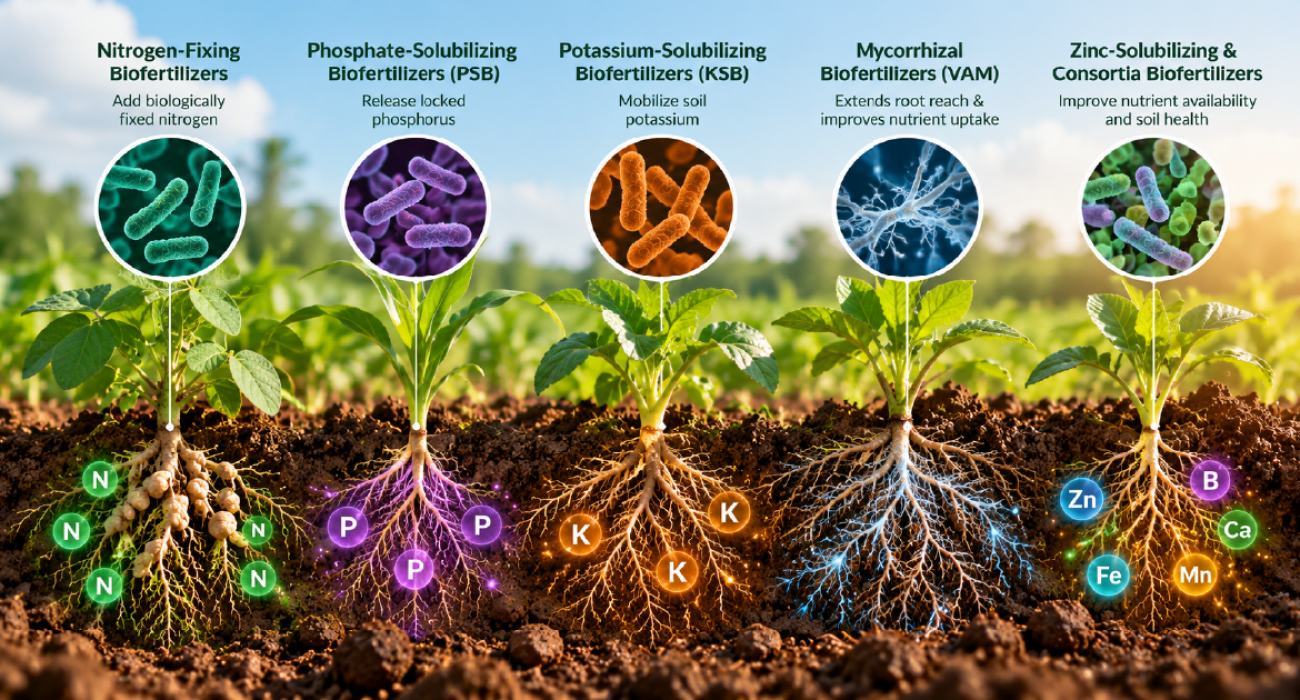
Biofertilizers are products containing living beneficial microbes that make nutrients available to crops. They fix nitrogen from the air, release phosphorus and potassium locked in the soil, and extend the reach of roots. The main types are nitrogen-fixing, phosphate-solubilizing (PSB), potassium-solubilizing (KSB), mycorrhizal (VAM), zinc-solubilizing and multifunctional consortia.
Key takeaways
- Biofertilizers unlock and supply nutrients; they do not work like a bag of urea.
- Use the right microbe for the right job: N-fixers for nitrogen, PSB for phosphorus, KSB for potash.
- Standard dose: 1 L per acre (liquid) or 1–2 kg per acre (powder), as per the pack label.
- Never mix with chemical fungicides or bactericides.
What Are Biofertilizers?
A biofertilizer contains live bacteria or fungi that colonise the seed, root or soil. Once active, these microbes convert nutrients into forms plants can absorb.
Indian soils often hold large reserves of phosphorus and potassium that crops simply cannot use. A good part of the phosphorus from DAP also gets fixed in the soil soon after application. Biofertilizers release these locked nutrients, add biologically fixed nitrogen and improve soil life season after season.
Biofertilizer vs Chemical Fertilizer vs Biostimulant
Biofertilizer | Chemical fertilizer | Biostimulant | |
|---|---|---|---|
What it is | Living microbes | Mineral salts (urea, DAP, MOP) | Substances or microbes that boost plant processes (seaweed, humic acid, amino acids) |
How it works | Fixes, solubilizes or mobilizes nutrients | Supplies nutrients directly | Improves uptake, growth and stress tolerance |
Speed | Gradual | Fast | Moderate |
Effect on soil | Improves soil biology | Long-term overuse degrades soil | Improves soil and plant health |
Regulated under (India) | Fertilizer Control Order, 1985 | Fertilizer Control Order, 1985 | FCO, 1985 — Schedule VI |
Want to know more about biostimulants? Read Biostimulants in India: FCO Rules, Types & How to Buy Genuine.
6 Types of Biofertilizers
1. Nitrogen-Fixing Biofertilizers
These microbes convert atmospheric nitrogen into ammonia that plants can use.
- Rhizobium — Lives in root nodules of legumes (pulses, groundnut, soybean).
- Azotobacter — Free-living; used for non-legume crops like cotton, vegetables and wheat.
- Azospirillum — Lives close to roots of cereals, millets, maize and sugarcane; also produces growth-promoting substances.
- Acetobacter — Associated mainly with sugarcane.
According to government extension data, Rhizobium can lift legume yields by 10–35%, Azotobacter by 10–15% and Azospirillum by 10–20%, depending on crop and soil conditions.
Varsha product: NITROMAX® — nitrogen-fixing biofertilizer in liquid, powder and granular forms.
2. Phosphate-Solubilizing Bacteria (PSB)
PSB such as Bacillus and Pseudomonas species release organic acids that dissolve insoluble phosphate in the soil. The result: stronger roots, better flowering and more efficient use of applied DAP or SSP.
Varsha product: PHOSPHOMAX®
3. Potassium-Solubilizing / Mobilizing Bacteria (KSB / KMB)
These bacteria release potassium bound in soil minerals. Potash improves grain filling, fruit size, shine, shelf life and disease tolerance.
Varsha product: POTAZ®
4. Mycorrhizal Biofertilizers (VAM)
Vesicular Arbuscular Mycorrhiza (VAM) fungi attach to roots and send fine threads deep into the soil, acting like an extended root system. They improve phosphorus, micronutrient and water uptake and help crops handle drought. VAM works best at nursery and transplanting stage.
Varsha product: VARSHA VAM
5. Zinc-Solubilizing Bacteria
Zinc deficiency is common in paddy and maize soils. Zinc-solubilizing bacteria release zinc already present in the soil, reducing hidden hunger in crops.
6. Multifunctional Consortia
A consortium combines several beneficial microbes in one pack — one application for multiple nutrients.
Varsha product: RHIZODYNE® — improves availability of nitrogen, phosphorus, potassium, zinc, manganese, boron, iron and calcium.
Quick Reference Table
Type | Key microbes | What it does | Best for | Varsha product |
|---|---|---|---|---|
Nitrogen-fixing | Rhizobium, Azotobacter, Azospirillum | Adds biologically fixed nitrogen | Pulses, cereals, cotton, sugarcane | NITROMAX® |
PSB | Bacillus, Pseudomonas spp. | Releases locked phosphorus | All crops | PHOSPHOMAX® |
KSB / KMB | Potash-mobilizing bacteria | Releases soil potassium | Fruits, vegetables, oilseeds, cereals | POTAZ® |
VAM | Mycorrhizal fungi | Extends root reach; P and water uptake | Horticulture, nursery, transplanted crops | VARSHA VAM |
Zinc-solubilizing | Bacillus, Pseudomonas spp. | Releases soil zinc | Paddy, maize | RHIZODYNE® |
Consortium | Multiple strains | N, P, K + micronutrients in one pack | All crops | RHIZODYNE® |
Biofertilizer Dosage per Acre
Application method | Liquid formulation | Powder formulation | How to apply |
|---|---|---|---|
Seed treatment | 10 ml per kg seed | 10–20 g per kg seed | Coat seeds, dry in shade, sow the same day |
Seedling root dip | Per-acre dose in about 40 L water | Per-acre dose in about 40 L water | Dip roots 20–30 minutes before transplanting |
Soil application | 1 L per acre | 1–2 kg per acre | Mix with 50–100 kg FYM or compost, apply at sowing |
Drip irrigation | 1 L per acre | — | Run through drip; keep chemicals out of the tank |
These rates match NITROMAX® (1 L/acre) and RHIZODYNE® (1–2 kg/acre). Always follow the dosage printed on your pack.
How to Apply Biofertilizers: Step-by-Step
Seed treatment
- Mix the biofertilizer with a little cooled jaggery water to make a sticky slurry.
- Spread seeds on a clean sheet and pour the slurry evenly.
- Mix gently until every seed is coated.
- Dry in shade for 20–30 minutes.
- Sow the same day.
Soil application
- Mix the per-acre dose with 50–100 kg well-decomposed FYM or compost.
- Sprinkle water to keep it moist. Leave overnight in shade.
- Broadcast in the field at sowing or apply along crop rows.
- Irrigate lightly if the soil is dry.
Crop-Wise Biofertilizer Guide (Telangana & Andhra Pradesh Crops)
Crop | Recommended biofertilizers | When |
|---|---|---|
Paddy | Azospirillum + PSB + zinc solubilizer | Nursery root dip + main field |
Cotton | Azotobacter + PSB + KSB | Seed treatment + basal |
Maize | Azospirillum + PSB + zinc solubilizer | Seed treatment + basal |
Red gram, green gram, black gram | Rhizobium + PSB | Seed treatment |
Groundnut | Rhizobium + PSB | Seed treatment |
Chilli, tomato, brinjal | Azotobacter + PSB + KSB + VAM | Nursery + transplanting |
Turmeric | Azospirillum + PSB + KSB + VAM | Basal with FYM |
Sugarcane | Acetobacter / Azospirillum + PSB | Sett treatment + soil |
Banana, pomegranate, citrus | VAM + PSB + KSB | Planting pit + basin application |
Simplest option: a consortium like RHIZODYNE® covers N, P, K and micronutrients in one application.
Pair biofertilizers with a bio fungicide for root protection — see our Trichoderma viride guide.
Storage and Compatibility Rules
- Store in shade in a cool, dry place. Heat and sunlight kill live microbes.
- Do not freeze and do not keep near fertilizer bags or pesticides.
- Do not mix with chemical fungicides or bactericides. If seeds are chemically treated, apply biofertilizers to the soil instead.
- Apply chemical fertilizers separately. Do not dissolve urea or DAP in the same solution.
- Use before the expiry date.
Can Biofertilizers Replace Chemical Fertilizers?
Not overnight. The practical approach is integrated nutrient management: use biofertilizers, organic manure and a reduced, soil-test-based chemical dose together.
Start with a modest reduction in chemical nitrogen and phosphorus, compare yield and crop health with your usual practice, and adjust over two to three seasons. As soil organic matter and microbial activity build up, the response to biofertilizers improves.
2026 Update: New FCO Rule on Biofertilizer Pack Sizes
The Ministry of Agriculture and Farmers Welfare notified standard pack sizes for bio-fertilisers under the Fertiliser Control Order, effective April 1, 2026 (Notification S.O. 1567(E)). The aim is uniform, compliant products in the market.
What it means for you: Buy biofertilizers only from licensed manufacturers, check that the label shows batch number, manufacturing date, expiry and composition, and always take a bill.
Why Choose Varsha Biofertilizers?
Varsha Bioscience has developed biological crop inputs in Hyderabad since 2003. Our range covers every major nutrient pathway — nitrogen, phosphorus, potassium, mycorrhiza and multi-nutrient consortia — in liquid, powder and granular forms.
Frequently Asked Questions
1. What are the main types of biofertilizers?
Nitrogen-fixing (Rhizobium, Azotobacter, Azospirillum), phosphate-solubilizing (PSB), potassium-solubilizing (KSB), mycorrhizal (VAM), zinc-solubilizing and multifunctional consortia.
2. What is the dosage of biofertilizer per acre?
Generally 1 L per acre for liquid and 1–2 kg per acre for powder formulations. Follow the product label.
3. Which biofertilizer is best for paddy?
Azospirillum for nitrogen, PSB for phosphorus and a zinc solubilizer. A consortium like RHIZODYNE® covers all three.
4. Is liquid biofertilizer better than powder?
Liquid formulations are easier to apply through drip and usually have a longer shelf life. Powder works well for FYM enrichment and soil broadcasting. Both are effective when used correctly.
5. Can I mix different biofertilizers together?
Yes. N-fixers, PSB and KSB are generally compatible and are often applied together or sold as consortia.
6. Can biofertilizers be used with urea and DAP?
Yes, in the same crop — but apply them separately. Do not mix biofertilizers directly with chemical fertilizers in one solution.
7. How long do biofertilizers take to show results?
Root vigour often improves within a few weeks. Soil fertility benefits build up over successive seasons.
Sources
- ICAR — Biofertilizer Technologies: https://icar.gov.in/sites/default/files/2022-06/ICAR-technologies-Biofertilizers.pdf
- Vikaspedia — Biofertilizers: https://vikaspedia.in/agriculture/agri-inputs/bio-inputs/bioinputs-for-nutrient-management/biofertilizers
- Chaudhary et al. (2022), Frontiers in Plant Science — Overview of biofertilizers: https://www.ncbi.nlm.nih.gov/pmc/articles/PMC9445558/
- Global Agriculture — FCO pack-size notification for bio-fertilisers (March 2026): https://www.global-agriculture.com/crop-nutrition/india-notifies-standard-pack-sizes-for-bio-fertilisers-under-fco-effective-april-1-2026/
Disclaimer: Always follow the product label and consult your local agriculture officer or KVK for crop-specific recommendations.