

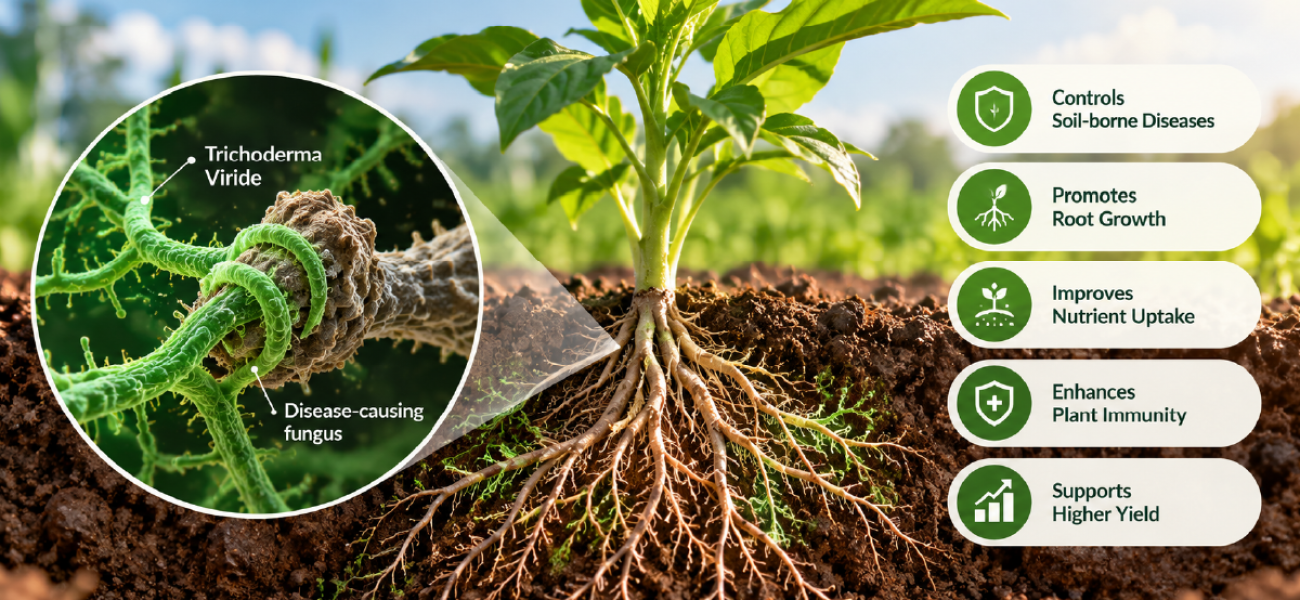
Trichoderma viride is a beneficial soil fungus used as a bio fungicide. It protects crop roots from soil-borne diseases such as root rot, damping-off and wilt, and improves root growth and nutrient uptake. For a 1% WP formulation, the standard dosage is 1–2 kg per acre, applied through seed treatment, FYM enrichment, soil drenching or drip irrigation.
Key takeaways
- Trichoderma is a protector, not a rescue spray. Apply before disease appears.
- The most effective method is FYM enrichment: multiply it in manure for 7–10 days, then apply to soil.
- Never tank-mix with chemical fungicides. Keep a 7-day gap.
- It needs moisture and organic matter to survive and multiply.
What Is Trichoderma Viride?
Trichoderma viride is a naturally occurring fungus found around the roots of plants in healthy soil. It is sold as a wettable powder (WP) or liquid and is one of the most widely used biological fungicides in India — across vegetables, pulses, oilseeds, spices, fruit crops and plantations.
Unlike a chemical fungicide, Trichoderma is alive. Once applied, it settles in the root zone (rhizosphere) and keeps multiplying as long as the soil has moisture and organic matter. That is why a single well-timed application protects for longer than one chemical spray.
How Trichoderma Viride Works
Trichoderma protects crops in four ways:
- Mycoparasitism — It coils around disease-causing fungi and feeds on them.
- Competition — It grows fast and occupies the root surface first, leaving no space or food for pathogens.
- Antibiosis and enzymes — It releases antifungal compounds and enzymes that break down the cell walls of harmful fungi.
- Induced resistance — It switches on the plant’s own defence system, so the crop resists later attacks better.
The bonus: Trichoderma also stimulates root branching. More roots mean better water and nutrient uptake — especially useful in stress-prone rainfed fields.
Diseases Controlled by Trichoderma Viride
|
Disease |
Common pathogen |
Crops commonly affected |
|---|---|---|
|
Damping-off |
Pythium, Rhizoctonia |
Chilli, tomato, brinjal, onion nurseries |
|
Root rot / dry root rot |
Rhizoctonia, Macrophomina |
Red gram, black gram, chickpea, groundnut, cotton |
|
Wilt |
Fusarium spp. |
Tomato, red gram, chickpea, banana, cotton |
|
Collar rot / stem rot |
Sclerotium rolfsii |
Groundnut, chilli, tomato |
|
Rhizome rot |
Pythium |
Turmeric, ginger |
|
Seed rot and seedling blight |
Various soil fungi |
Most field crops |
Trichoderma Viride Dosage per Acre
The doses below are for BHOOMIKA® (Trichoderma viride 1% WP). Always follow the label on your pack.
|
Application method |
Dosage |
How to apply |
|---|---|---|
|
Seed treatment |
10 g per kg seed |
Make a slurry with a little water, coat seeds evenly, dry in shade for 20–30 minutes, sow the same day |
|
Seedling root dip |
10 g per litre of water |
Dip roots for 20–30 minutes just before transplanting |
|
FYM enrichment (best) |
1–2 kg in 100 kg FYM |
Incubate 7–10 days in shade, then apply to 1 acre |
|
Soil drench / nursery |
10 g per litre of water |
Drench around the stem base or nursery beds |
|
Drip irrigation |
1–2 kg per acre |
Mix in water, filter, run through drip in the last cycle |
|
Rhizome, tuber, sett or cutting treatment |
10 g per litre of water |
Dip planting material for 20–30 minutes before planting |
How to Enrich FYM with Trichoderma (Step-by-Step)
FYM enrichment multiplies Trichoderma spores many times before they reach your field. It is the single most effective way to use it.
- Take 100 kg of well-decomposed FYM or compost. Never use fresh dung — the heat kills the fungus.
- Add water until the manure is moist but not dripping. A fistful should hold its shape.
- Mix 1–2 kg BHOOMIKA® evenly through the heap. Optional: add 5–10 kg neem cake.
- Heap it in shade and cover with wet gunny bags.
- Turn the heap every 3–4 days and sprinkle water to keep it moist.
- After 7–10 days, white-green fungal growth appears. The mix is ready.
- Broadcast over 1 acre at the last ploughing, or apply in the root zone or planting pits.
For orchards (banana, pomegranate, mango, citrus): apply enriched FYM in the plant basin at planting and again before and after the monsoon, quantity based on plant age.
Seed Treatment with Trichoderma: Step-by-Step
- Take 10 g Trichoderma per kg of seed.
- Add just enough water (with a little jaggery) to form a thin slurry.
- Mix with seed until every seed is coated.
- Dry in shade for 20–30 minutes. Never in direct sun.
- Sow the same day.
Tip: If you also use a biofertilizer like Rhizobium or PSB, treat with Trichoderma first, then the biofertilizer. If seeds are already coated with a chemical fungicide, skip seed treatment and apply Trichoderma to the soil instead.
Crops That Benefit Most
Trichoderma viride suits almost every crop. It gives the clearest results in:
- Vegetables: chilli, tomato, brinjal, okra, onion, cucurbits
- Pulses: red gram, black gram, green gram, chickpea
- Oilseeds and cotton: groundnut, sunflower, cotton
- Spices: turmeric, ginger
- Fruit crops: banana, pomegranate, papaya, citrus
- Paddy nurseries, plantations and floriculture
Trichoderma Viride vs Trichoderma Harzianum
|
Point |
Trichoderma viride |
Trichoderma harzianum |
|---|---|---|
|
Type |
Beneficial fungus, bio fungicide |
Beneficial fungus, bio fungicide |
|
Targets |
Soil-borne fungal diseases |
Soil-borne fungal diseases |
|
Common use |
Seed treatment, nursery and soil application in field crops and vegetables |
Soil application in vegetables, fruit crops and plantations |
|
Root-growth effect |
Yes |
Yes |
|
Varsha products |
Bottom line: Both species are proven. Choose the one recommended for your crop and region. Not sure? Call our agronomy team at +91-8285684222.
Compatibility: What to Mix and What to Avoid
Compatible
- Biofertilizers — Rhizobium, Azotobacter, PSB, KSB (see our biofertilizer guide)
- Pseudomonas fluorescens — AGNEE®
- Neem cake, FYM, vermicompost
Avoid
- Chemical fungicides and bactericides in the same tank or on the same day. Keep a 7-day gap.
- Tank-mixing with any chemical without checking with our team.
- Do not use in mushroom units. Trichoderma causes green mould in mushroom beds.
7 Common Mistakes That Make Trichoderma Fail
- Applying on dry soil. No moisture, no growth.
- Mixing with chemical fungicides. It kills the fungus instantly.
- Storing packs in sun or a hot vehicle. Heat destroys spores.
- Using an expired pack. Viable spore count drops over time.
- Waiting until the crop is already wilting. Trichoderma prevents; it does not cure dead roots.
- Mixing with fresh dung. Heat from fermentation kills it.
- Skipping organic matter. Without FYM or compost, Trichoderma has nothing to feed on.
Why Farmers Choose BHOOMIKA®
BHOOMIKA® contains Trichoderma viride 1% WP. It controls root rot, damping-off, stem rot and wilt; improves soil microbial activity; and supports stronger roots. It works through seed treatment, root dipping, tuber treatment, soil broadcasting, drenching and foliar spray.
Varsha Bioscience has manufactured biological crop inputs in Hyderabad since 2003.
Frequently Asked Questions
1. What is Trichoderma viride used for?
It is a bio fungicide that protects crops from soil-borne diseases like root rot, damping-off, collar rot and wilt, and improves root growth.
2. What is the dosage of Trichoderma viride per acre?
For a 1% WP formulation like BHOOMIKA®, use 1–2 kg per acre. For seed treatment, use 10 g per kg of seed.
3. Can Trichoderma be mixed with chemical fungicides?
No. Chemical fungicides kill Trichoderma. Keep a gap of at least 7 days.
4. When is the best time to apply Trichoderma?
At sowing or transplanting, before disease appears. Apply to moist soil, preferably in the evening.
5. How long does Trichoderma take to work?
Its protection builds as it colonises the root zone, typically over the first one to two weeks. That is why early application matters.
6. Is Trichoderma safe for humans, animals and bees?
It is a naturally occurring soil fungus used widely in organic farming. Wear gloves and a mask while handling the powder.
7. Can I apply Trichoderma through drip irrigation?
Yes. Mix the dose in water, filter it and run it through the drip system in the last irrigation cycle.
8. How should I store Trichoderma?
In a cool, dry, shaded place away from sunlight, fertilizers and chemicals. Check the expiry date before use.
Disclaimer: Dosage guidance is for BHOOMIKA® (Trichoderma viride 1% WP). Always follow the product label and consult your local agriculture officer or KVK for crop-specific advice.